The Admiral’s Headache at Asya Geisberg Gallery, Review on Hyperallergic by John Yau
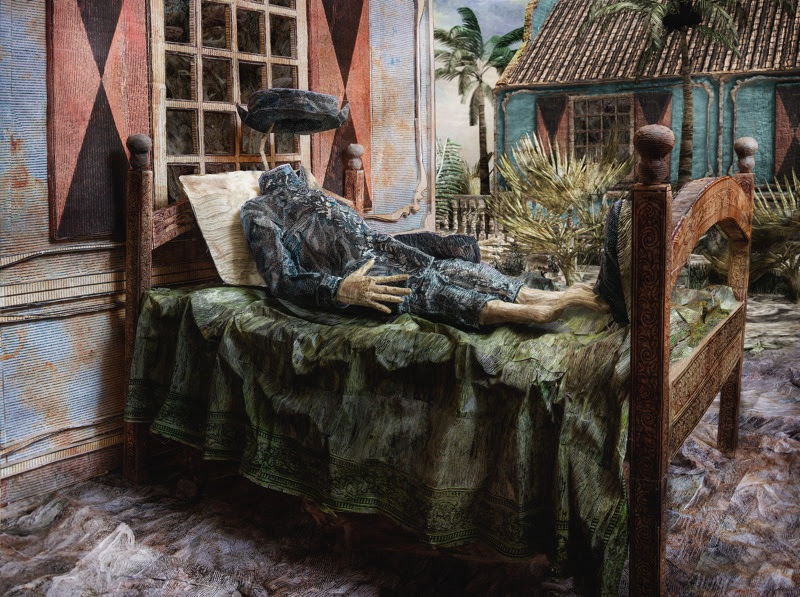
“In “Brigadier” (C-Print, 39.37 by 52.76 inches, 2019), de Beijer has photographed a headless figure lying on a bed that appears to be outside. The shutters on the window behind him are geometrically divided into four triangles, echoing the emblem on the containers in “Refinery.” The brigadier’s uniform and skin have been brought into clarity by the highly detailed, printed surface that de Beijer has applied to his carefully built-up volumetric form.
The fact that we see his calves, a hand, and a forearm, but that he is headless, is strange and unsettling, especially as the artist has placed a hat above the empty collar, supported by what looks like a crooked stick rising up from the back of the empty uniform. In fact, there are no faces in the photographs, only empty uniforms. “Brigadier” is downright weird, oddly funny, somewhat creepy, and unnerving.
Why can’t we see the Brigadier’s face? Is he a surrogate for one part of Dutch history, at once visible and gone? What is the present’s relationship to the past? Aren’t different nations at a crucial juncture as they try to shape and reshape their bonds with the past? These are issues that de Beijer makes visible without becoming didactic. That he moves so nimbly from one subject to another — from a refinery to a brigadier lying in bed to a night sky lit up by glowing paths culminating in explosions that reveal the land plantations and slave huts below — is what convinced me that he is a major artist whose challenging work should be better known in America.”
Read more on Hyperallergic here.
Virtual Studio Visit (from May 1st)
Jasper de Beijer and Asya Geisberg discuss the artist’s latest photography series “The Admiral’s Headache”, on view at the gallery through May 15, 2021. Directly from his studio in Amsterdam, De Beijer shows examples of his paper models and background material, and explains his ideas, research, and process behind the series.
The photographs in “The Admiral’s Headache” reference 18th-century hand-colored engravings. From a distance, these photographs look like seamless colonial paintings, but up close the tell-tale clues of the cut paper reveal themselves. The new series expands on the artist’s familiar themes of Dutch colonialism and the way that the media romanticizes, simplifies and conflates history and cultural attitudes.
Watch the studio visit HERE.
ASYA GEISBERG GALLERY
To reserve a viewing time, click HERE or email INFO@
537B West 23rd Street
New York, NY 10011
VIEW MAP
Tel: 212 – 675 – 7525, Email: info@
Asya Geisberg Gallery accepts payment plans offered by ART MONEY.
Jasper de Beijer at Asya Geisberg Gallery (Solo)
Asya Geisberg Gallery presents
The Admiral’s Headache
by Jasper de Beijer
April 10 – May 15, 2021
Go to the online viewing room HERE.
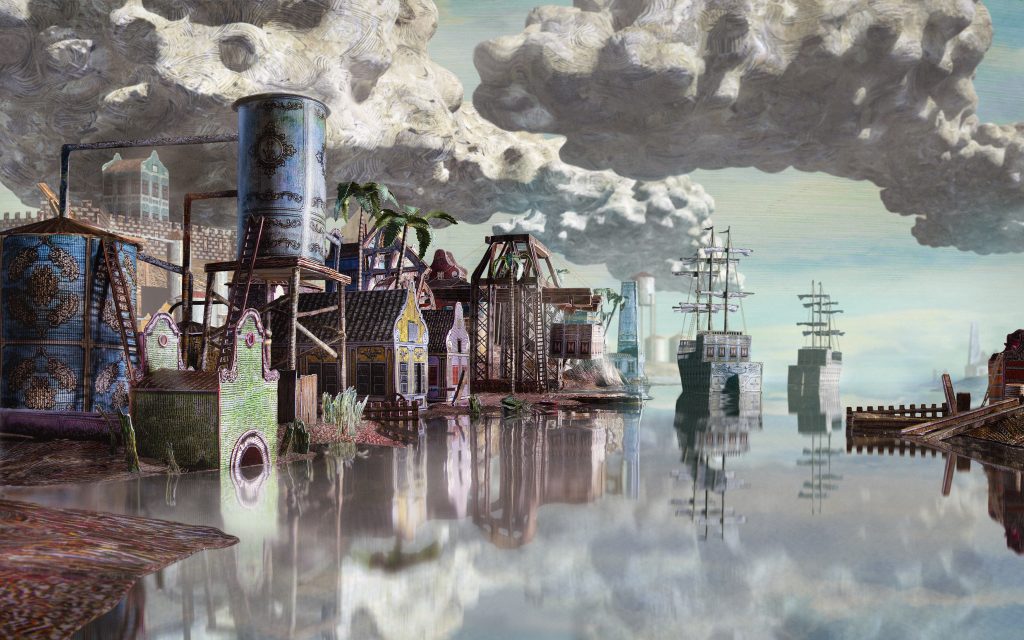
Asya Geisberg Gallery is proud to present “The Admiral’s Headache”, the fourth solo exhibition of photographic works by Jasper de Beijer. The new series expands on the artist’s familiar themes of Dutch colonialism and the way that the media romanticizes, simplifies and conflates history and cultural attitudes. De Beijer chooses subjects for their strong visual mythology, and past series have included mythical encounters between natives and explorers in the jungles of Brazil, the Dutch East Indies, and contemporary Africa. In each series, the artist becomes steeped in research and image collection both on the ground and at home. De Beijer then combines digital sketching, drawing, 3D modeling, and sculpture to create stand-alone photographs. Every object in this series is first designed in a game-modeling software, then printed as a flat 2D blueprint, cut out and folded, and finally reconfigured as 3D paper miniatures on a scale-model landscape. The photographs in this series reference 18th-century hand-colored engravings, and from a distance could be colonial illustrations. But upon closer viewing, the meticulous hand-drawn lines are imbued with an eerie sci-fi quality. The tell-tale clues of the cut paper reveal themselves: creases and folds in costumes, or some remains of glue visible in the clouds.
 Jasper de Beijer
The Admiral’s Headache: “Refinery”, 2020
C-Print
41.73h x 66.93w in
106h x 170w cm
Edition of 7 + 1AP
The title “The Admiral’s Headache” refers to the story of Albert Kikkert, the former admiral and Governor of Curaçao in the early 1800’s. Kikkert complained that the white facades of the buildings shining in the sun exacerbated his migraines, and ordered that they all be painted the bright shades typical of Curaçao’s waterfront today. During de Beijer’s residency in this former Dutch colony, the artist collected research, focusing primarily on the methodical approach to slavery and capital extraction. De Beijer depicts a desolate, surreal and industrial realm – an island riddled with fantastic machines waiting to be involuntarily powered by extracted human labor. Intrigued by the unique modular, hermetic character of its buildings, ships, tools, and weapons, de Beijer recreated a world where the colonists are hidden players, present but unseen behind imposing mansions. The artist describes the Dutch as being kept comfortable and safe inside the walls, “like an impenetrable cultural cocoon”. The hard shell of the fortress protected the famed Dutch gezelligheid – a coziness, warmth, and conviviality – and kept out anything unseemly or dangerous, much like the reality of slavery’s exploitation could be ignored while living within the Dutch simulacra.
 Jasper de Beijer
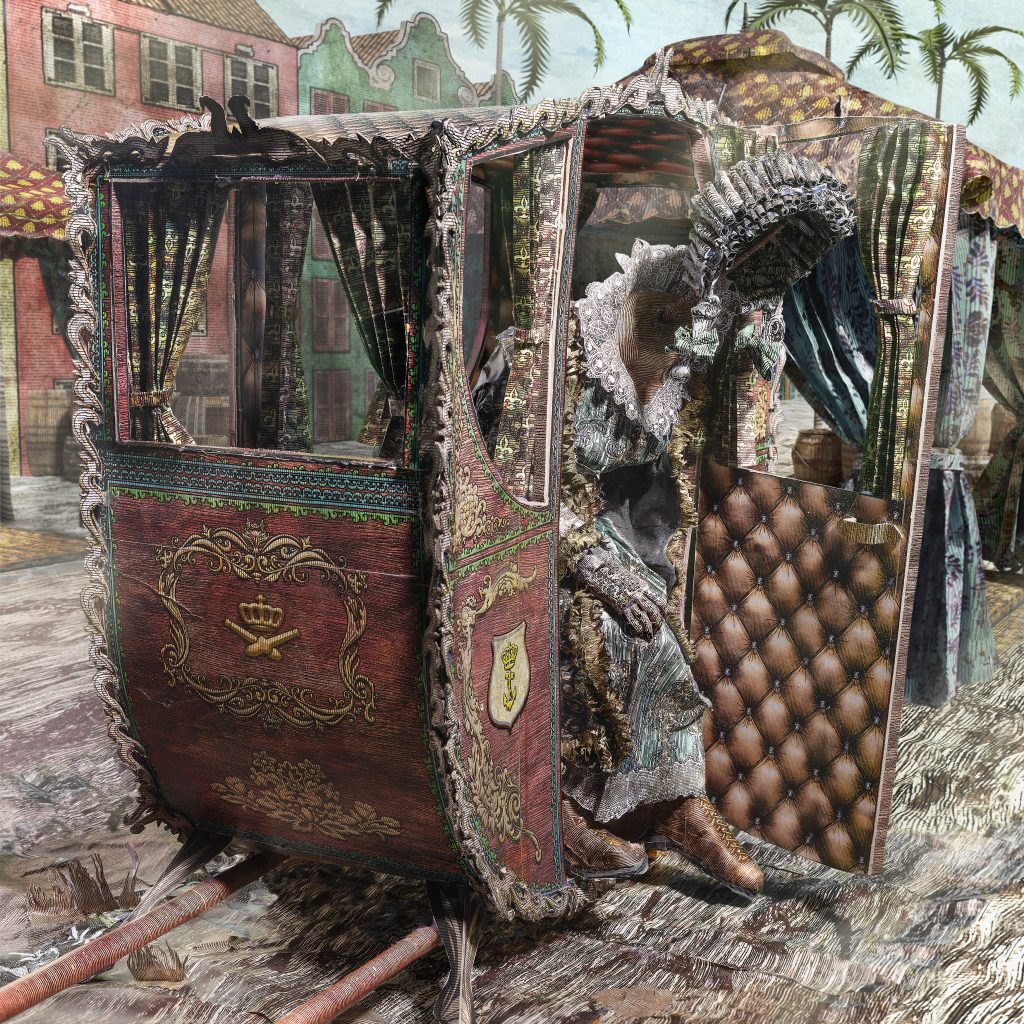
The Admiral’s Headache: “Carriage”, 2019
C-Print
43.31h x 43.31w in
110h x 110w cm
Edition 3 of 7 + 1AP
The stripped-out colonialist lurks around Curaçao with a ghost-like omnipresence, appearing in traces of puffs, gunpowder shots, or magical smoke emanating from fired cannons. But the enslaved people who powered every aspect of this island are left entirely unseen, haunting our collective imagination. De Beijer’s intention is not so much to give a moral judgment on colonialism, but to transform its particularly Dutch aspects into oneiric tableaux.
 Jasper de Beijer
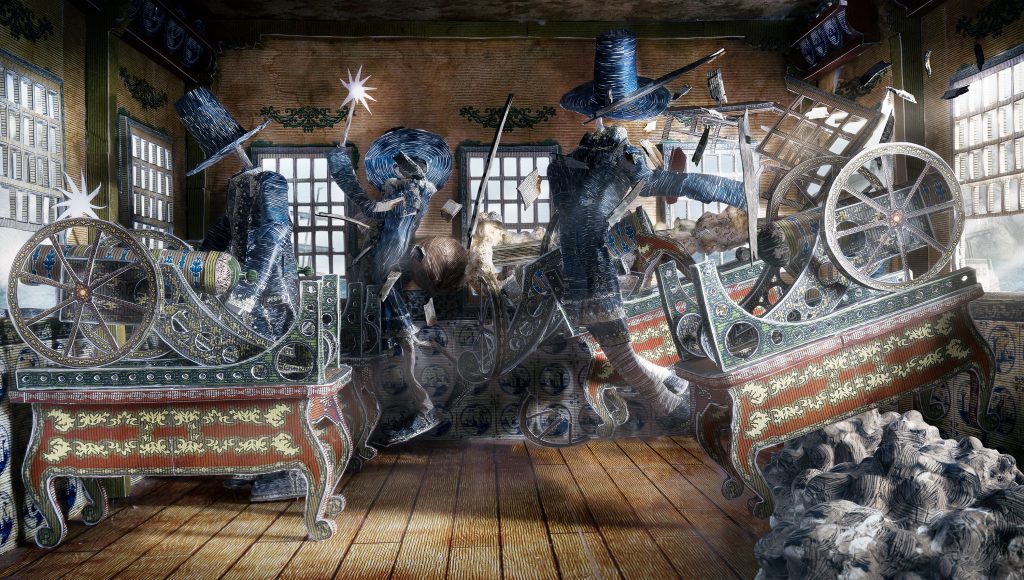
The Admiral’s Headache: “Cabin”, 2021
C-Print
31.50h x 55.12w in
80h x 140w cm
Edition of 7 + 1AP
ASYA GEISBERG GALLERY
The gallery is open Tuesday through Saturday, 11am – 6pm. Walk-ins are welcome dependent on capacity; masks are required. For updates, please continue to check the AGG website, and Instagram at @asyageisberggallery
537B West 23rd Street
New York, NY 10011
VIEW MAP
Tel: 212 – 675 – 7525, Email: info@asyageisberggallery.com, Hours: Tues-Sat, 11-6pm.
Asya Geisberg Gallery accepts payment plans offered by ART MONEY.
Review Het Parool 26-02-2021 by Edo Dijksterhuis

Edo Dijksterhuis, 26 februari 2021
Jasper de Beijer – The Admiral’s Headache
Capsule Presentation *
Tot vandaag was het werk van Jasper de Beijer (1973) vooral te zien op tentoonstellingen in Franse, Belgische en Nederlandse musea (Fotomuseum Den Haag, WIELS, Brussel, Centre Photographique Rouen, Frankrijk) en op prestigieuze groepstentoonstellingen als Art Brussel, PAN Amsterdam en Paris Photo. Met plezier toont FLATLAND vanaf zaterdag 13 februari dan ook voor het eerst in de galerie enkele werken van De Beijer uit ‘The Admiral’s Headache’.
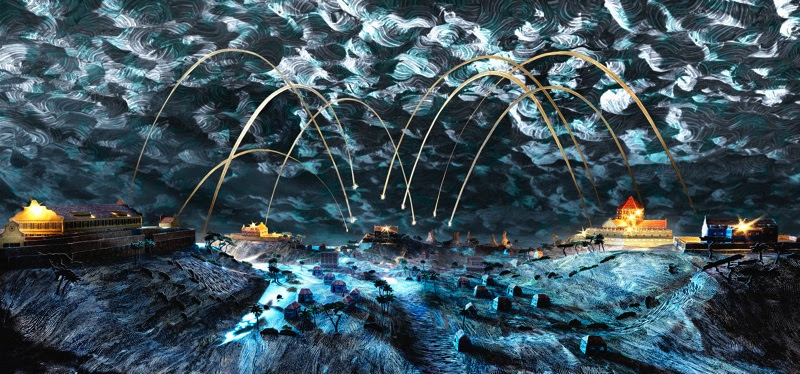
Jasper de Beijer, The Admiral’s Headache – Bastion, 2020,180 x 84 cm, Pigment print (with frame 187,0 x 91,2 cm) Edition of 7 + 1 AP
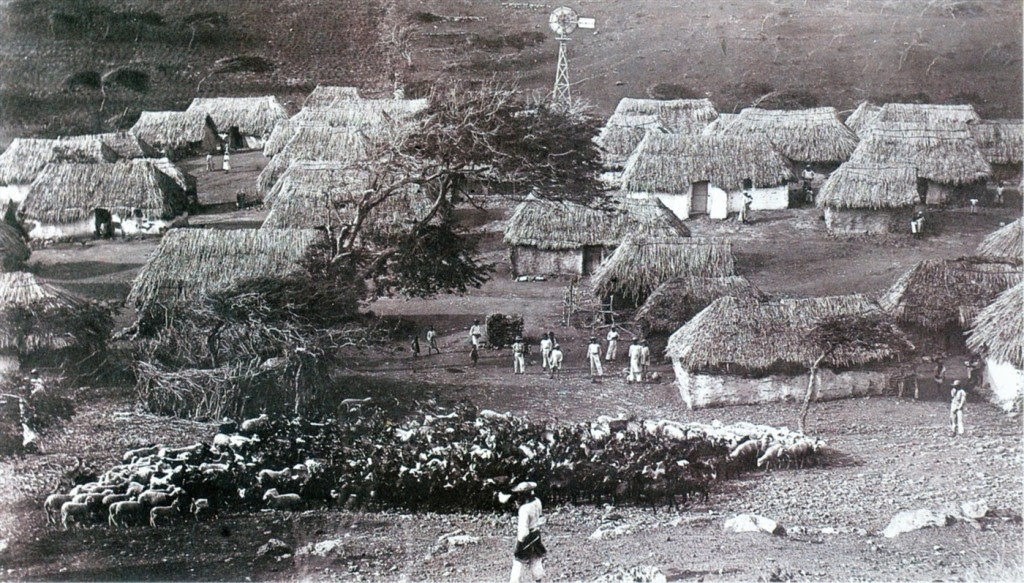
Voormalige plantage op Curaçao (1880)
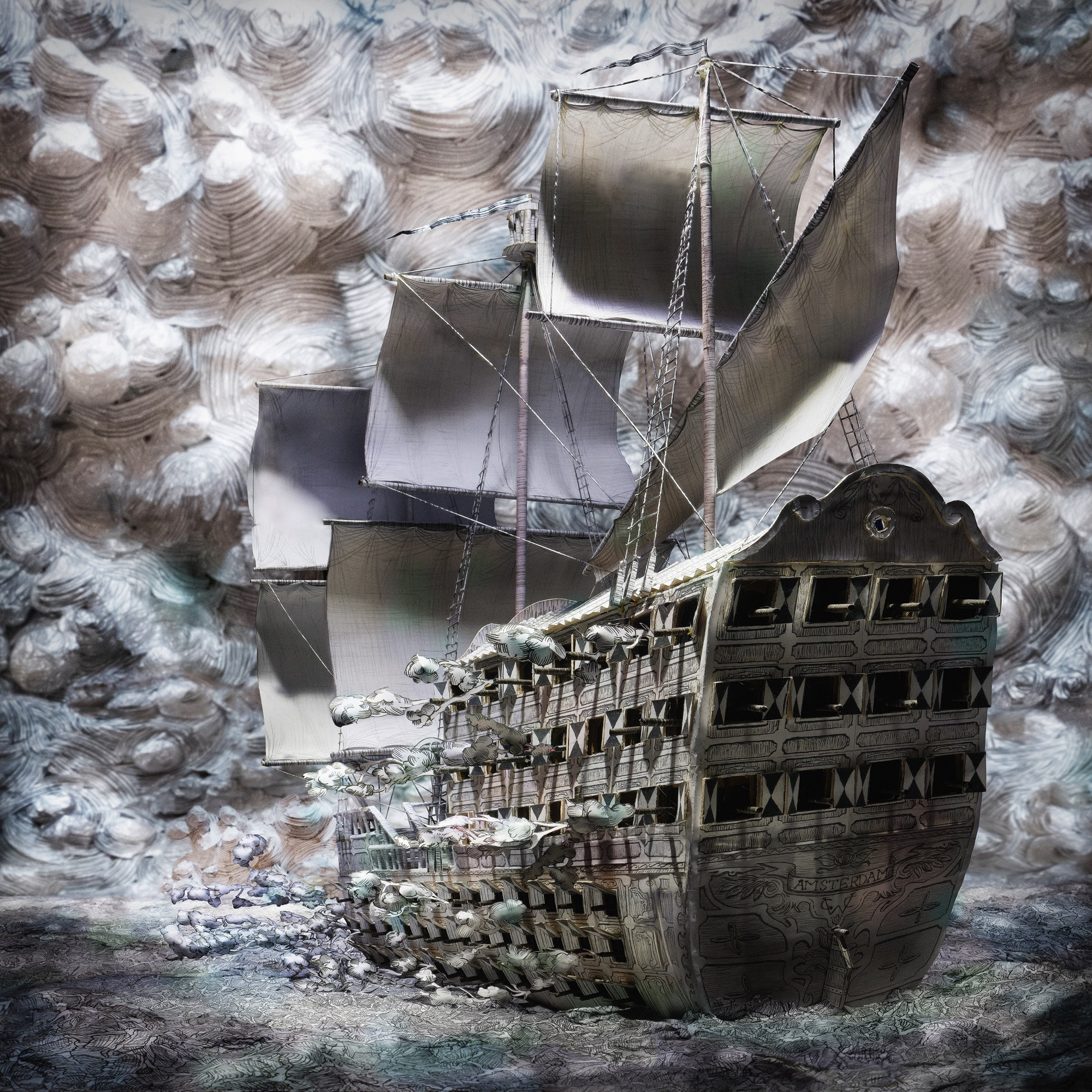
Jasper de Beijer, The Admiral’s Headache – Galjoen, 2018,110 x 110 cm,
c-print, Edition of 7 + 1 AP
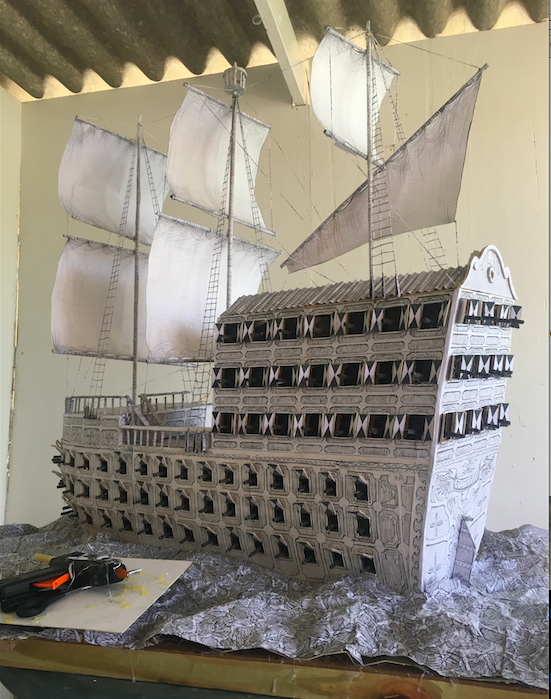
A work in progress, Jasper de Beijer
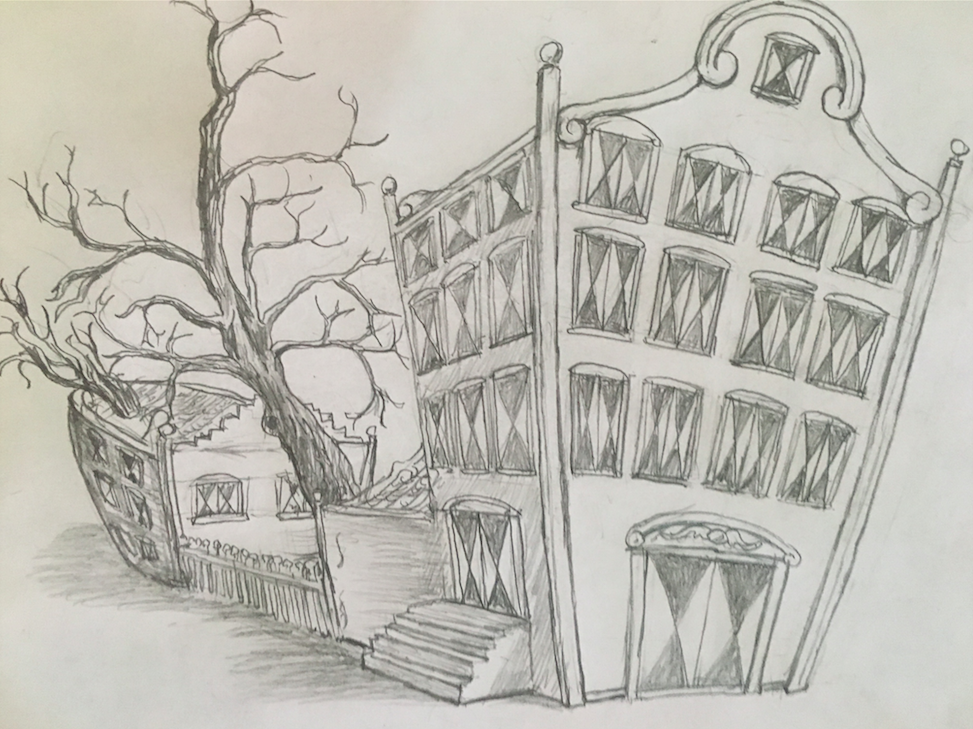
Sketch, a work in progres, Jasper de Beijer
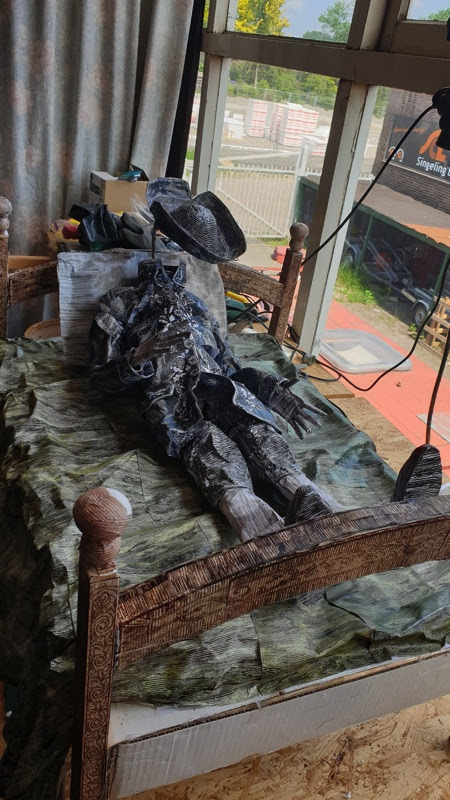
A work in progress, Jasper de Beijer
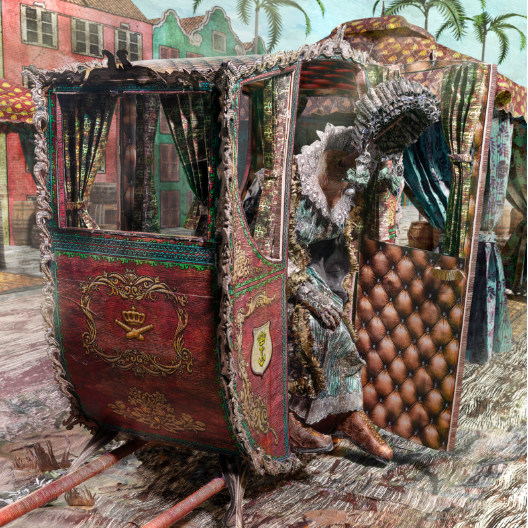
Jasper de Beijer, The Admiral’s Headache – Koets, 2019,134 x 110 cm, c-print, Edition of 7 + 1 AP
——————ENGLISH—————-
13 February – 13 March, 2021
Capsule Presentation *
Until today, the work of Jasper de Beijer (1973) has mainly been shown at exhibitions in French, Belgian and Dutch museums (Fotomuseum The Hague, WIELS, Brussels, Center Photographique Rouen, France) and at prestigious group exhibitions such as Art Brussels, PAN Amsterdam and Paris Photo. From Saturday 13 February, FLATLAND is therefore pleased to show some works by De Beijer from “The Admiral’s Headache” for the first time in the gallery.
Jasper de Beijer, The Admiral’s Headache – Bastion, 2020,180 x 84 cm, Pigment print (with frame 187,0 x 91,2 cm) Edition of 7 + 1 AP
Voormalige plantage op Curaçao (1880)
In De Beijer’s photo collages he shows us emotionally charged, sensational and evocative images from the past or from faraway places. From apocalyptic situations (the Brazilian Suitcase) about expeditions in the Amazon in which the Indian people build a temple of straw with a trophy around a crashed expedition plane. Or images (Le Sacre du Printemps) to Diaghilev’s ballet, in which horse and rider explode simultaneously, as one aesthetic rearrangement of mud, stone and iron.
Jasper de Beijer, The Admiral’s Headache – Galjoen, 2018,110 x 110 cm,
c-print, Edition of 7 + 1 AP
Up close one can see the handmade, simple models and self-built sets that De Beijer constructed with little more than ink, paper, adhesive tape, glue and nails. In its vulnerability, this imperfection betrays that we knowingly surrender to nostalgia and – this is one more tragic fate – that we allow ourselves to be manipulated unconsciously.
A work in progress, Jasper de Beijer
Sketch work in progress, Jasper de Beijer
The series The Admiral’s Headache was created as a result of De Beijers residency at the Instituto Buena Bista in Curaçao in 2017. Here he faced the gaudy, restaurated remains of the Dutch 17th-century architecture: canal houses in bright colors and decorated bunkers that are located at monumental locations and from where African people in slavery were ruled over. “Also the interior of these Curaçao mansions were a copy of typical Dutch farmhouses interiors; as if they had Dutch culture locked up inside their walls, like a Dutch cocoon ”, says De Beijer.
Jasper de Beijer, The Admiral’s Headache – Brigadier, 2019,134 x 110 cm, c-print, Edition of 7 + 1 AP
In The Admirals Headache, the settlers are present in their absence. As hidden players, they are only invisibly present behind their facades or in their empty uniforms.
A work in progress, Jasper de Beijer
In the panoramic work “Bastion” from “The Admiral Headache”, bright arcs of lights twinkle against a dark sky, fired from the Dutch fortresses at invisible ships of different European origins, crossing the slave houses overhead that lie scattered over the hills. In “De Brigadier” De Beijer depicts the expensive costume of power as a hard but empty shell, deflated on the bed. Here too, the human dimension is absent. And the bearers of the work “De Koets” are nowhere to be seen, like the classical door opening scenes from the spaceships in science fiction movies. For De Beijer these carriages are the symbol of the ultimate seclusion from the outside world, which is controlled and suppressed.
Jasper de Beijer, The Admiral’s Headache – Koets, 2019,134 x 110 cm, c-print, Edition of 7 + 1 AP
* Capsule Presentations at FLATLAND are smaller and more condensed exhibitions that are shorter in period, following or partly overlapping the main gallery shows, with different art works presented.
JASPER DE BEIJER AT PHOTO LONDON (DIGITAL ART FAIR)
Flatland Gallery at the Photo London Digital
Kim Boske, Jasper de Beijer, Paolo Ventura
6 October – 20 October, 2020
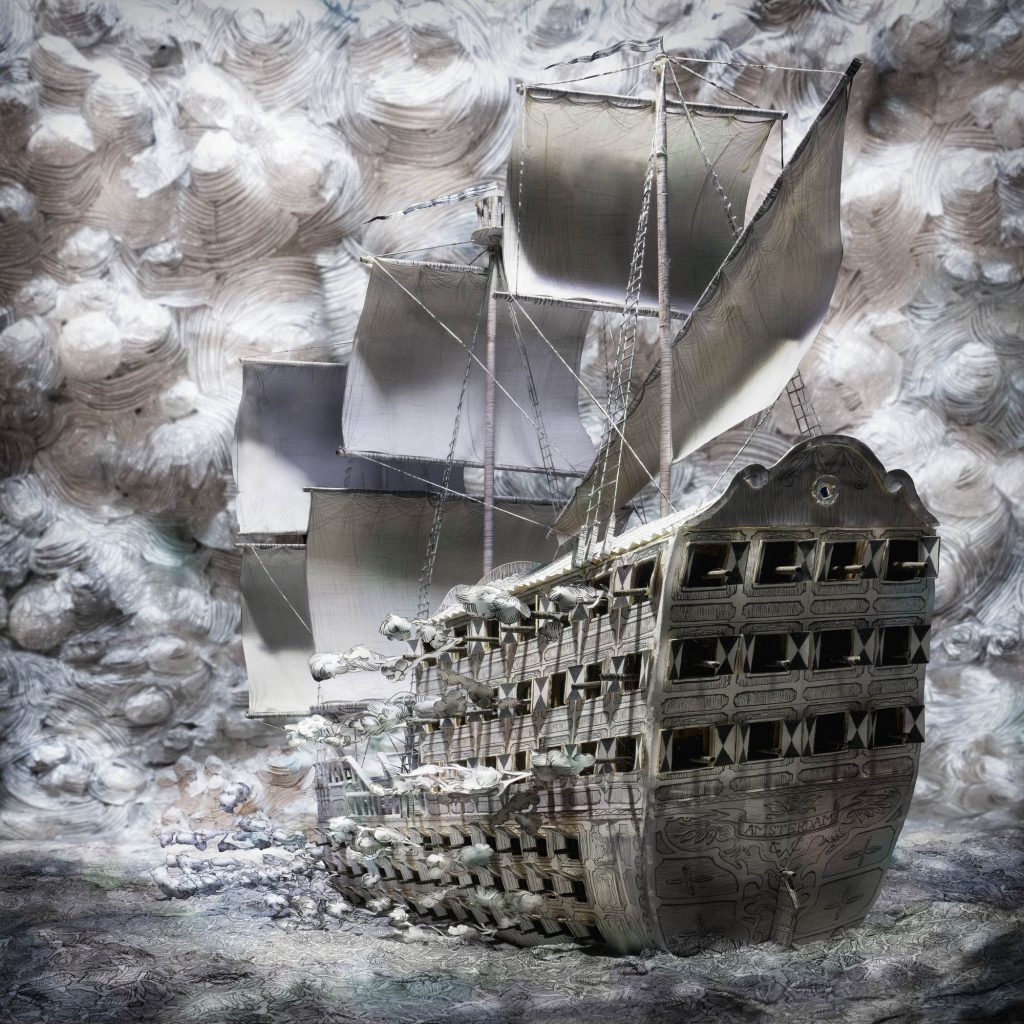 Jasper de Beijer, “The Admiral’s Headache: Galjoen”, C-print, 110 x 110 cm
JASPER DE BEIJER AT RESIDU 5 — GROUP SHOW
Kunsthal 45 presents:
RESIDU 5
September 6 to November 1, 2020
(Dutch below)
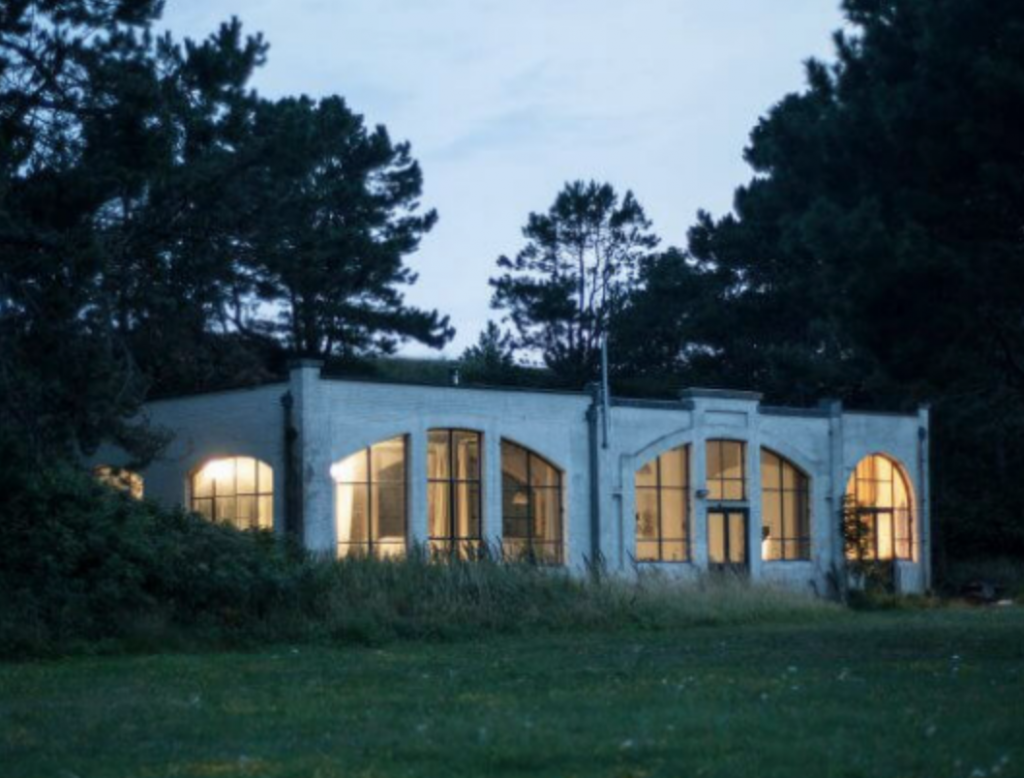
In collaboration with the Mondriaan Fund, Kunsthal 45 is organizing the exhibition Residu 5, the 5th exhibition of artists who have worked at the Pompgemaal in Den Helder. The Pompgemaal is a Residency of the Mondriaan Fund in Huisduinen near Den Helder. The 9 artists who stayed there over the past 2 years show a record of their work period. The works vary from paintings and drawings to installations and video.
A publication will accompany the exhibition.
Participating artists in Residu 5:
Danielle van Vree
Timo Demollin
Niels Vis & Merel van ‘t Hullenaar
Maurice Bogaert, Paul Klemann
Jasper de Beijer
Kim David Bots
Marie Reintjes
The opening is only accessible after reservation. Those interested in the opening can register by email: info@kunsthal45.nl
The maximum allowed number is 35.
Kunsthal 45 presenteert:
RESIDU 5
6 september t/m 1 november 2020
In samenwerking met het Mondriaan Fonds organiseert Kunsthal 45 de tentoonstelling Residu 5, de 5e expositie van kunstenaars die in Het Pompgemaal in Den Helder gewerkt hebben. Het Pompgemaal is een Residency van het Mondriaan Fonds in Huisduinen bij Den Helder. De 9 kunstenaars die de afgelopen 2 jaar daar verbleven laten een neerslag zien van hun werkperiode.
De werken variëren van schilderijen en tekeningen tot installaties en video.
Bij de tentoonstelling verschijnt een publicatie.
Deelnemende kunstenaars aan Residu 5:
Danielle van Vree
Timo Demollin
Niels Vis & Merel van ‘t Hullenaar
Maurice Bogaert, Paul Klemann
Jasper de Beijer
Kim David Bots
Marie Reintjes
De opening is uitsluitend toegankelijk na reservering. Belangstellenden voor de opening kunnen zich opgeven per email: info@kunsthal45.nl
Het maximale toegelaten aantal is 35. De volgorde van binnenkomst van de email is bepalend.
Deze tentoonstelling is mogelijk gemaakt dankzij het Mondriaanfonds
AGNES VAN DEN BRANDELER MUSEUM PRIZE 2020 GOES TO MUSEUM RIJSWIJK

Marabunta #08 | 2012 | 200 x 115 cm | edition of 7 | c-print
DUTCH BELOW
Amsterdam / Rijswijk, the 20th of april 2020
Museum Rijswijk is the winner of the Agnes van den Brandeler Museum Prize 2020. The prize, worth 50 thousand euros, is awarded annually to a small to medium-sized Dutch museum that comes up with a special plan for a solo exhibition. This year the jury selected an exhibition proposal by curator Diana Wind. She will make an extensive solo with earlier work and new projects by the Dutch artist Jasper de Beijer (1973) at Museum Rijswijk.
De Beijer will make a large, new installation in the new wing of the museum. The other spaces will be filled with earlier work by the artist; photo series, installations and videoworks. De Beijer makes carefully constructed and exhilarating photo works. As an image composer he disenchants the reality of the present and past – and creates a new, mysterious reality. In that reality he raises issues about cultural ethnicity, the elusive nature of history and the fictional aspects of the here and now.
The project proposal from Museum Rijswijk for Jasper de Beijer was selected by the jury of the Agnes van den Brandeler prize from a shortlist of museums. The jury, consisting of the board of the Agnes van den Brandeler Foundation – Frank Bergevoet, Robert de Haas and Koeno Sluyterman Van Loo – and supplemented by art critic Lucette ter Borg, finds de Beijers’ work committed, critical and stunningly beautiful. Museum Rijswijk is a small but high quality museum that has been presenting an interesting variety of exhibitions in recent years.
The Agnes van den Brandeler Museum Prize – instituted in 2018 – is an annual prize for medium-size and small museums. The prize is accompanied by an amount of 50,000 euros, intended for a project in which an artist (born before 1978) who, according to the taste of the jury, has been underexposed the past years. The prize is also intended as a financial stimulus for medium-size and small museums.
Damsel Agnes van den Brandeler (1918-2002) was a Dutch artist. Very much against the will of (especially) her father she decided to attend the RoyalAcademy of Visual Arts in The Hague after the completion of her high school. After the war, she traveled between 1947 and 1972 to France, Spain, Greece and Italy. She provided for her maintenance by painting, drawing and teaching. During her travels she became acquainted with impressionism, expressionism and constructivism and experimented between styles. In particular expressionism enhused her: she remained her whole life, even after returning to the Netherlands, making landscapes and history paintings in this style. During her life, Agnes van den Brandeler exhibited regularly – and funny detail: she had her debute in Museum Rijswijk -, but never broke through seriously. On one hand she found that disappointing, on the other hand, she always dreaded “the social stuff”. The Agnes van den Brandeler Foundation – set up by herself and her husband – takes care of her artistic legacy and keeps the memory of this special, very energetic artist alive, among other things by the introduction of the annual AvdB prize.
For more information: jury and board member Robert de Haas: 06-21557915
Diana Wind – Museum Rijswijk: 06-30388366
AGNES VAN DEN BRANDELER MUSEUMPRIJS 2020 NAAR MUSEUM RIJSWIJK
Amsterdam / Rijswijk, 20 april 2020
Museum Rijswijk is de winnaar van de Agnes van den Brandeler Museumprijs 2020. De prijs, ter waarde van 50 duizend euro, wordt jaarlijks uitgereikt aan een klein tot middelgroot Nederlands museum dat met een bijzonder plan voor een solotentoonstelling komt. Dit jaar gaf de jury de voorkeur aan een tentoonstellingsvoorstel van curator Diana Wind. Zij zal een omvangrijke solo maken met ouder en nieuw werk van de Nederlandse kunstenaar Jasper de Beijer (1973) in Museum Rijswijk.
De Beijer zal een grote, nieuwe installatie maken in de nieuwe vleugel van het museum. De overige ruimtes zullen worden ingericht met vroeger werk van de kunstenaar: foto’s van series, installaties en films. De Beijer maakt nauwkeurig geconstrueerde en bedwelmend mooie fotowerken. Als beeldcomponist onttovert hij de werkelijkheid van nu en die van vroeger, en creëert een nieuwe, raadselachtige werkelijkheid. In die werkelijkheid gaat het vaak om vragen over culturele etniciteit, de ongrijpbare aard van geschiedenis en de fictieve status van het hier en nu.
Het projectvoorstel van Museum Rijswijk voor Jasper de Beijer is door de jury van de Agnes van den Brandeler-prijs verkozen uit een shortlist van musea. De jury, bestaande uit het bestuur van de Agnes van den Brandeler Stichting – Frank Bergevoet, Robert de Haas en Koeno Sluyterman Van Loo – en aangevuld door kunstcritica Lucette ter Borg, vindt De Beijers werk geëngageerd, kritisch en beeldschoon. Museum Rijswijk is een klein maar kwalitatief uitstekend museum dat de laatste jaren met een interessante keur aan tentoonstellingen aan de weg timmert.
De Agnes van den Brandeler Museumprijs is een in 2018 ingestelde, jaarlijkse prijs voor middelgrote en kleine musea. Aan de prijs is een bedrag van 50.000 euro verbonden, bedoeld voor een project waarin een kunstenaar (geboren voor 1978) die naar de smaak van de jury net te weinig aandacht heeft gehad, uitgebreid wordt belicht. De prijs is eveneens bedoeld om middelgrote en kleine musea financieel te steunen.
Jonkvrouwe Agnes van den Brandeler (1918-2002) was een Nederlandse kunstenaar. Zeer tegen de zin van (vooral) haar vader besloot zij na de afronding van haar gymnasiumtijd naar de Koninklijke Academie voor Beeldende Kunsten in Den Haag te gaan. Na de oorlog reisde zij tussen 1947 en 1972 naar Frankrijk, Spanje, Griekenland en Italië. In haar onderhoud voorzag ze door te schilderen, te tekenen en lessen te geven. Tijdens haar reizen maakte zij kennis met het impressionisme, expressionisme en constructivisme en experimenteerde met alle stijlen. Met name het expressionisme trok haar: ze bleef haar leven lang, ook na terugkomst in Nederland, landschappen en historiestukken schilderen in deze stijl.
Agnes van den Brandeler exposeerde gedurende haar leven regelmatig – en grappig detail: voor het eerst in Museum Rijswijk -, maar brak nooit serieus door. Dat vond ze enerzijds teleurstellend, anderzijds zag ze ook altijd op tegen ‘het sociale gedoe’. De door haarzelf en haar man opgerichte Agnes van den Brandeler Stichting draagt zorg voor haar artistieke nalatenschap en houdt de herinnering aan deze bijzondere, zeer doortastende kunstenaar levend, onder andere door de instelling van bovenstaande prijs.
Voor meer informatie: jury- en bestuurslid Robert de Haas: 06-21557915
Diana Wind – Museum Rijswijk: 06-30388366
JASPER DE BEIJER AT POMPGEMAAL DEN HELDER
From the 1st of March until the 31st of May Jasper de Beijer will be doing a residency at the Pompgemaal in Den Helder. More soon…
JASPER DE BEIJER AT UNTITLED SAN FRANCISCO (GROUP SHOW)
Asya Geisberg Gallery at
UNTITLED San Francisco
Booth B11
VIP and press preview: Thursday Jan.16, 2 – 8pm
Friday, Jan. 17, 12 – 8pm
Saturday, Jan. 18. 12 – 6 pm
Sunday, Jan. 19. 12 – 6 pm
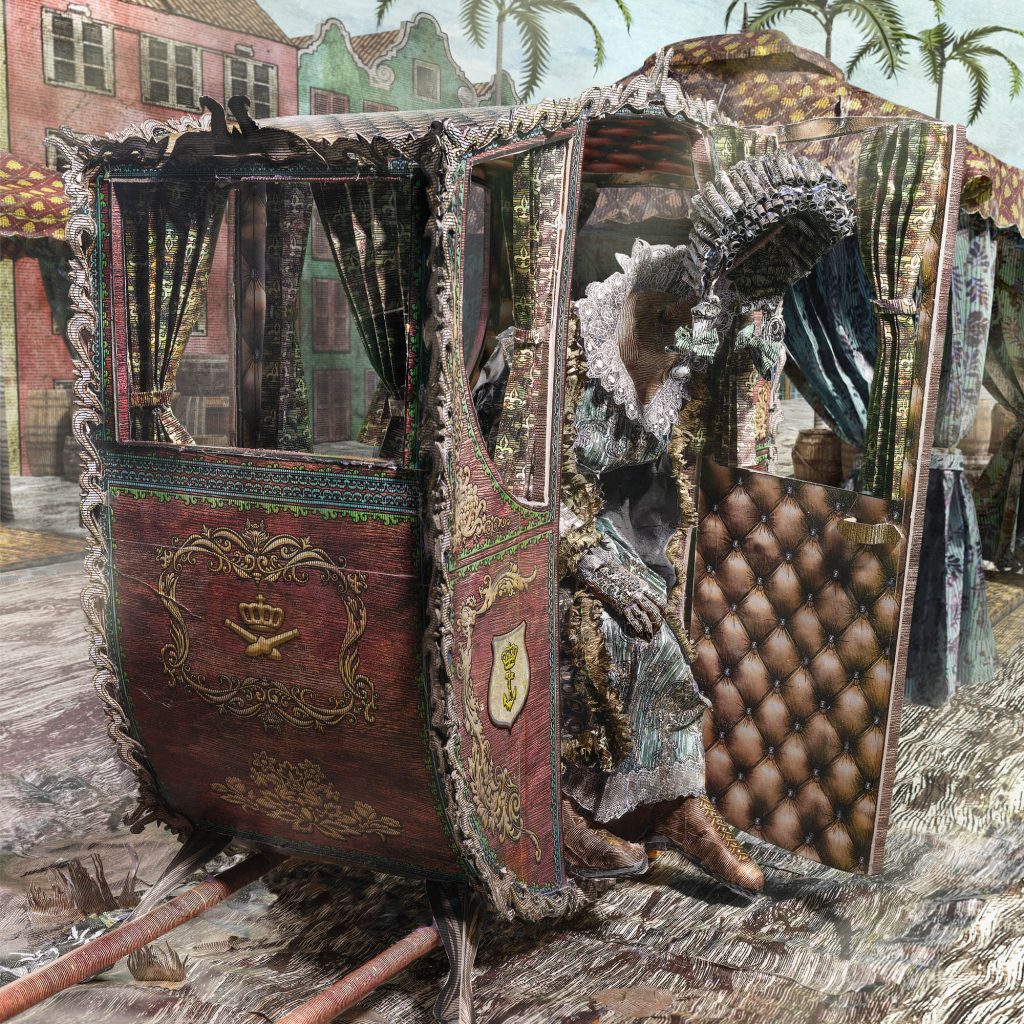 The Admiral’s Headache – Koets | 2019 | 110 x 110 cm | edition of 7 | c-print
The Admiral’s Headache – Galjoen | 2018 | 110 x 110 cm | edition of 7 | c-print
We are excited to be returning to UNTITLED San Francisco, where we will feature new works by Jasper de Beijer, Matthew Craven, and Melanie Daniel. De Beijer will debut two photos from his new series “The Admiral’s Headache,” about Dutch colonialism in Curaçao, created with both cut paper models and digital techniques. Craven will have collages of gems and mushrooms, on movie posters from the ’60s and 70’s. Daniel is continuing her series on climate change, with fantastical narratives of women and plants in a post-apocalyptic world.
For a full PDF catalog, detail images, or any additional information on our artists, please do not hesitate to contact us. We hope to see you at booth B11!
ASYA GEISBERG GALLERY
537B West 23rd Street
New York, NY 10011
(212) 675-7525